01
Biocoal
A dense, renewable solid fuel made from agricultural residues that fires boilers, kilns and power plants.

PRO IMPACT / PEOPLE + PLANET
Every tonne we make works for farmers, companies, energy systems and future generations. Explore the benefits, then estimate what a single project can create.
Residues become income. Biochar returns water, nutrients and life to the soil.
A second return from the same harvest.

CIRCULAR CARBON / KARI ENERGY
Farmers01 / PRODUCTS + IMPACT
Choose a product to see how it creates value for farmers, for companies, for the energy market and for the long-term health of the planet. The same tonne of biomass often serves all four, which is what makes a circular carbon economy so powerful.
02 / WHO BENEFITS
Income from residues, healthier soils and a share in verified carbon value.
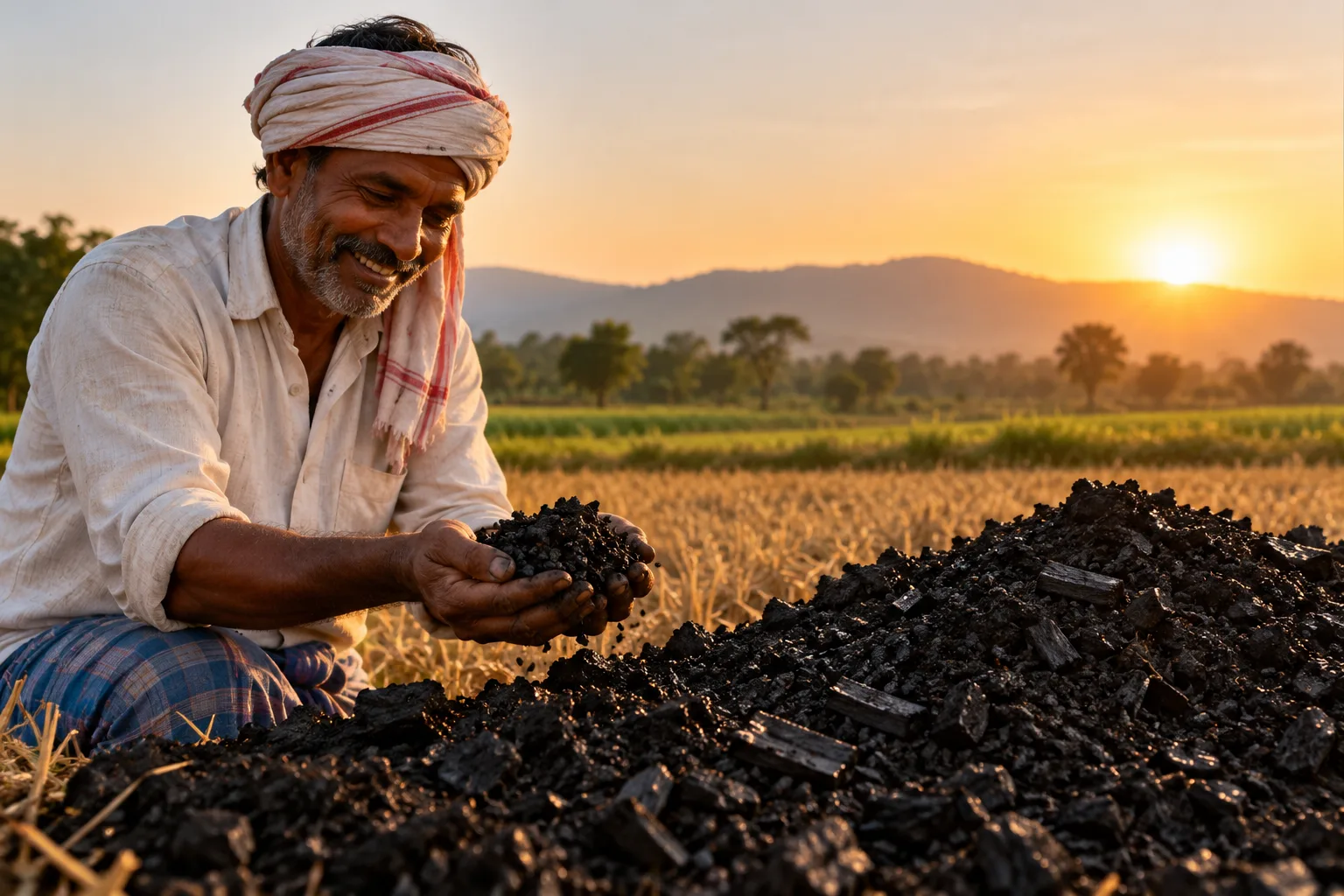
Income from every harvest — We collect residues after harvest and pay for them as raw material, turning a disposal cost into a new source of farm income.
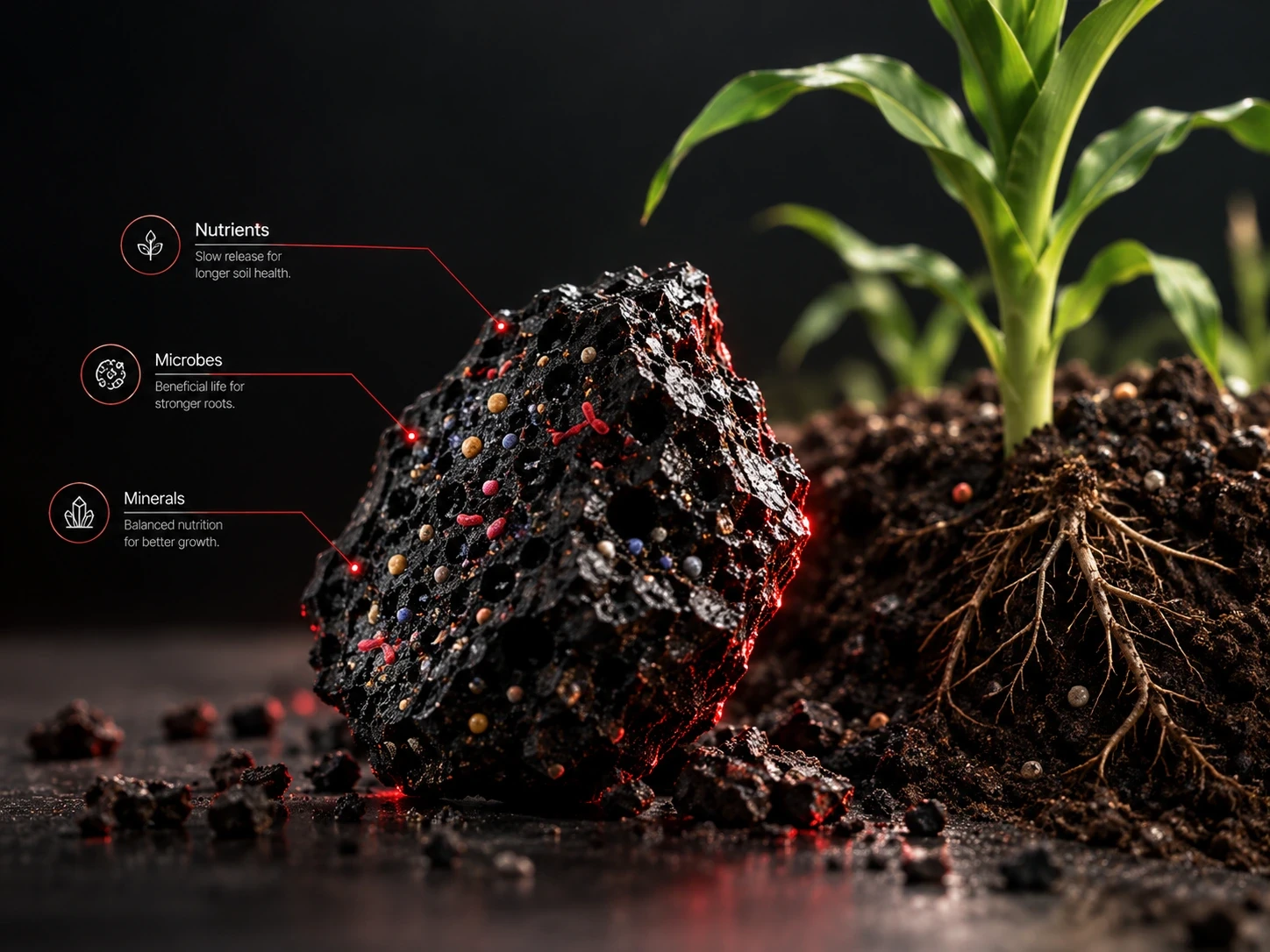
Healthier, more resilient soil — Biochar improves structure, water holding and nutrient retention, especially in Tamil Nadu’s sandy and red soils and seasons of uncertain rainfall.
More from every fertiliser application — Nutrient-loaded biochar keeps nitrogen, phosphorus and potassium close to roots, increasing uptake and reducing runoff.
A share in carbon value — Farmers and FPOs supplying biomass share in the verified removal value, creating a second return from the same harvest.
Cleaner air in the village — Every tonne collected is kept out of open-field fires, reducing harvest-season smoke for families.
Biochar pores hold water, nutrients and microbes in the root zone. Agronomy draws on Tamil Nadu Agricultural University; application rates are matched to each crop and soil.
CIRCULAR CARBON / KARI ENERGY
Farmers + producer organisations03 / LIVE PROJECT ESTIMATE
Set the annual dry biomass volume to see indicative farmland, biochar output and carbon removal. Project-specific figures are verified through dMRV.
Estimates assume 27% biochar yield, 1.6–2.4 tCO₂e net removal per tonne of biochar, 5 tonnes of residue per hectare and 300 operating days. Verified results come from project measurement under dMRV.
04 / LONG-TERM VALUE
Our work contributes to eight United Nations Sustainable Development Goals. Carbon removal, soil health, water treatment and local manufacturing reinforce one another.
Healthier soils support stable yields and food security on smallholder farms.
Activated carbon and biochar sorbents clean drinking water and industrial effluent.
Biocoal, process heat and carbon materials expand renewable energy and storage.
Collection, reactor operation and refining create skilled rural and industrial jobs.
Coimbatore-built reactors and materials research strengthen Indian manufacturing.
Residues and invasive biomass become valuable products in a circular economy.
Verified removal draws down carbon dioxide and stores it for centuries.
Clearing invasive species and restoring soils helps native ecosystems recover.
Partnerships connect farmers, researchers, industry, carbon buyers and verifiers to develop and scale durable carbon solutions.